

Introducing SimpleScreen™ CRC
Colon cancer screening made simple
Finding cancer often means invasive, expensive tests and procedures. And sometimes those tests don’t happen until it’s too late–when symptoms have already presented.

Colorectal cancer (CRC) is the second most common cause of cancer death in the United States1
The five-year survival rate when CRC is caught while still localized is 91%. But this rate falls to 13% once it has spread to a distant organ or site, and almost 40% of eligible adults are not up to date with screening.1, 2

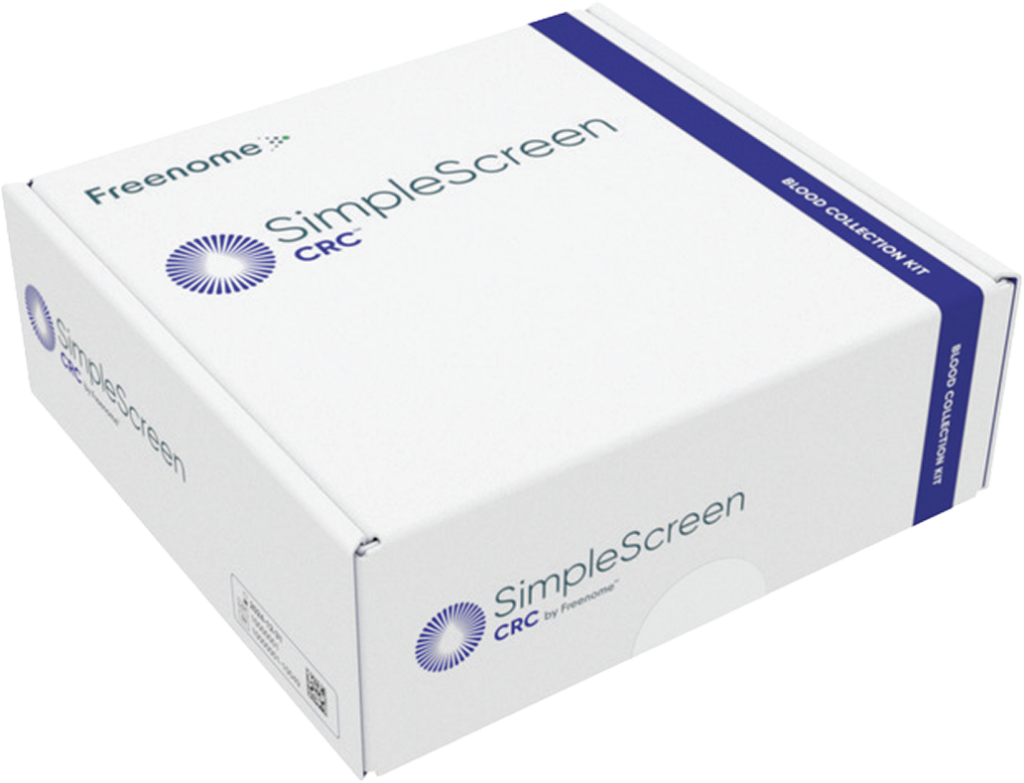
About SimpleScreen CRC
SimpleScreen CRC by Freenome is a non-invasive, blood-based screening test. It works by detecting the molecular signals of both CRC and advanced precancerous lesions (APLs) from cell-free DNA (cfDNA) found in the blood.
Why SimpleScreen CRC?
Adding the SimpleScreen CRC blood test as a CRC screening option for your patients can improve CRC screening participation.
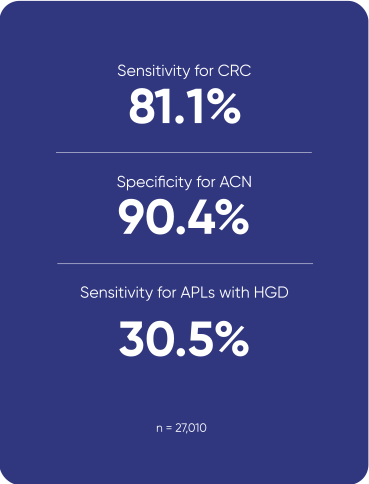
SimpleScreen CRC was validated in the PREEMPT CRC study, the largest study of its kind. The study showed 81.1% sensitivity for CRC, 90.4% specificity for advanced colorectal neoplasia (ACN) and 30.5% sensitivity for advanced precancerous lesions with high-grade dysplasia (HGD), all when adjusted to the age and sex distribution of the 2020 U.S. Census population.3, 4
The test is ordered like any routine lab: draw two tubes of blood, ship them to Freenome’s CLIA-certified laboratory and receive results in approximately two weeks.
How the SimpleScreen CRC blood test works
SimpleScreen CRC is designed to detect molecular signals associated with ACN, including CRC and APLs. The test analyzes circulating cfDNA extracted from plasma and uses a proprietary, machine learning–enabled classifier to identify methylation patterns indicative of CRC and APLs.
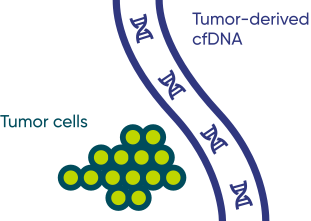
Tumor develops
Tumor cells shed cfDNA in the blood
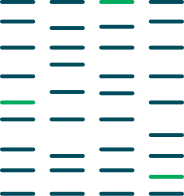
cfDNA sequencing
SimpleScreen CRC identifies DNA methylation patterns associated with CRC and APLs from circulating cfDNA

Al analysis
Data are analyzed by proprietary software, which includes an Al/ML-enabled classification algorithm
Clinical data
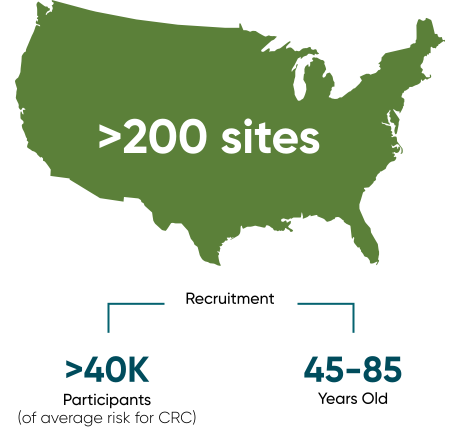
SimpleScreen CRC was validated across a diverse population in the PREEMPT CRC study, the largest clinical study of its kind, which was representative of the U.S. population in terms of age, race, ethnicity and sex.
The PREEMPT CRC study
Clinical performance
Additional study results
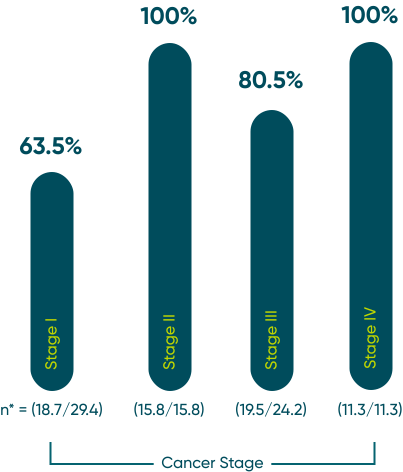
*Stage was reported for all except one CRC case, which was detected by the SimpleScreen CRC blood test. Stages were defined by the American Joint Committee on Cancer Staging System, 8th edition. U.S. Census-adjusted stage-specific n numbers were rounded to the nearest tenth.
Broadening access to CRC screening
SimpleScreen is a new screening test that simplifies finding cancer by combining advanced technologies. SimpleScreen provides powerful detection insights through a simple blood draw, making complex health information clear and available early, when it can make the most difference.
SimpleScreen CRC is made by Freenome. At Freenome, we believe that detecting cancer can make a world of difference. We are setting a new pace for cancer detection by combining the latest in science and artificial intelligence, with the ease of a standard blood draw.
Indications & contraindications
Indications for use
The test is indicated for adults aged 45 years and older who are at average risk for CRC and referred by a healthcare provider for CRC screening. A positive result may indicate the presence of CRC, APLs with HGD, or both and should be followed by colonoscopy. SimpleScreen CRC is not a replacement for diagnostic colonoscopy or for surveillance colonoscopy in high-risk individuals.
Contraindications
It is not indicated for individuals at increased or high risk for CRC, including those with:
- A personal history of CRC, APLs, or related cancers
- A family history of CRC (≥1 first-degree relatives diagnosed before the age of 60)
- Positive result on another CRC screening method within the last six months; completed a fecal occult blood test (FOBT) or a fecal immunochemical test (FIT) within the last 12 months; or completed a FIT-DNA test within the last 36 months
- Personal history of any of the following high-risk conditions for CRC:
- Hereditary non-polyposis colorectal cancer syndrome (HNPCC)
- Lynch syndrome
- Familial adenomatous polyposis (FAP)
- Inflammatory bowel disease (including Crohn’s disease or chronic ulcerative colitis)
- MUTYH-associated polyposis (MAP)
- Peutz-Jeghers syndrome, Cowden’s syndrome, or juvenile/serrated polyposis syndromes
Want to stay updated on SimpleScreen CRC?
If you are a healthcare professional, sign up to learn more.
1 Siegel RL, Kratzer TB, Giaquinto AN, Sung H, Jemal A. Cancer statistics, 2025. CA Cancer J Clin. 2025;75(1):10 45. Doi:10.3322/caac.21871
2 Bandi P, Star J, Mazzitelli N, et al. Prevalence and Review of Major Modifiable Cancer Risk Factors, HPV Vaccination, and Cancer Screenings in the United States: 2025 Update. Cancer Epidemiol Biomarkers Prev. 2025;34(6):836-849. Doi:10.1158/1055-9965.EPI-24-1835
3 Shaukat A, Burke CA, Chan AT, et al. Clinical validation of a circulating tumor DNA based blood test to screen for colorectal cancer. JAMA. 2025;334(1):56 63. Doi:10.1001/jama.2025.7515
4 Data on file